

Five Simple Ways to Validate Your B2B SaaS Idea (Before You Write a Line of Code)
Are You Building a Solution or a Problem?
You have a promising B2B SaaS idea. Before you spend time or money building it, ask one simple question:
Does the customer actually have this problem, and would they pay for a solution?
If you’re not technical, that’s okay. Your biggest advantage right now is speed and unbiased inquiry. You don’t need a working app to prove demand; you need clear evidence from customers.
Below are five simple, non-technical ways we use at E3 Digital to turn an assumption into a validated business hypothesis. We explain each step in straightforward language and show how to do it without jargon or heavy tooling.
How E3 Helps (Also: How You Can Do This Yourself)
We help founders run focused, practical validation work. When we explain what we do, we do it in plain terms and share the results you can expect. If you want us to run this for you, we’ll lead the process; if you prefer DIY, these steps are easy to follow.
The Five Validation Ways
- Problem-First Interviews (Talk to People)
Goal: Learn whether the people you want to sell to really feel the pain you think they do.
What to Do (2–7 days): Talk to at least 10 potential customers. Don’t pitch a product. Ask about their daily work, their frustrations, and what they’ve tried already.
What to Watch For: Emotional language; frustration, urgency, or time spent trying to fix the problem. That’s the signal that the problem matters.
- Simple Landing Page or Outreach Test (Measure Interest, Not Perfection)
Goal: See if people will take a clear next step (like signing up or requesting early access).
What to Do (1 week): Create a one-page description of the problem and the outcome (not a feature list). Share it where your customers already are; social groups, forums, email lists, or a small ad test if you want.
Practical Tip: Use absolute numbers, not tiny percentages. Aim to get a meaningful number of sign-ups or requests (for example, 10+ signups or several requested demos) to show real interest. Small percentages can be misleading with very small audiences.
Alternative: Manual outreach works well. Go to where your customers are and ask them directly. Do the things that don’t scale at first (personal messages, calls, or manual demos).
- Competitor Gap Analysis (Know What’s Missing)
Goal: Find what competitors miss so you can focus your product on the gap customers actually care about.
What to Do (2–3 days): Identify the top 2–3 competitors. Read their reviews, support threads, and customer discussions. Note the problems customers still complain about.
When to Do This: Do this early, right after you identify who your customer is. Knowing the gap helps you pick the right interviews and the right messages.
- Interactive Prototype & Usability Test (Replace Code with Interaction)
Goal: Test the core user flow before writing code.
What to Do (3–7 days): Build a simple interactive prototype (use any user-friendly tool, e.g. Figma). Show the key flow (sign-up, main action, result) to 5–10 people and watch them try to complete tasks.
What You Learn: You’ll find confusing steps or missing details that are cheap to fix in a prototype but expensive to change in code.
- Pricing and Purchase Intent (Ask About Money the Right Way)
Goal: Check whether customers would actually pay enough to make your business viable.
What to Do (2–3 days): In later interviews, ask about budgets and current solutions. You can run simple pricing questions, but avoid jargon. Explain it plainly (for example, “Would you pay this per month or per user?”). Focus on whether customers have budgets and are willing to spend on a solution.
Structure and Speed Over Guesswork
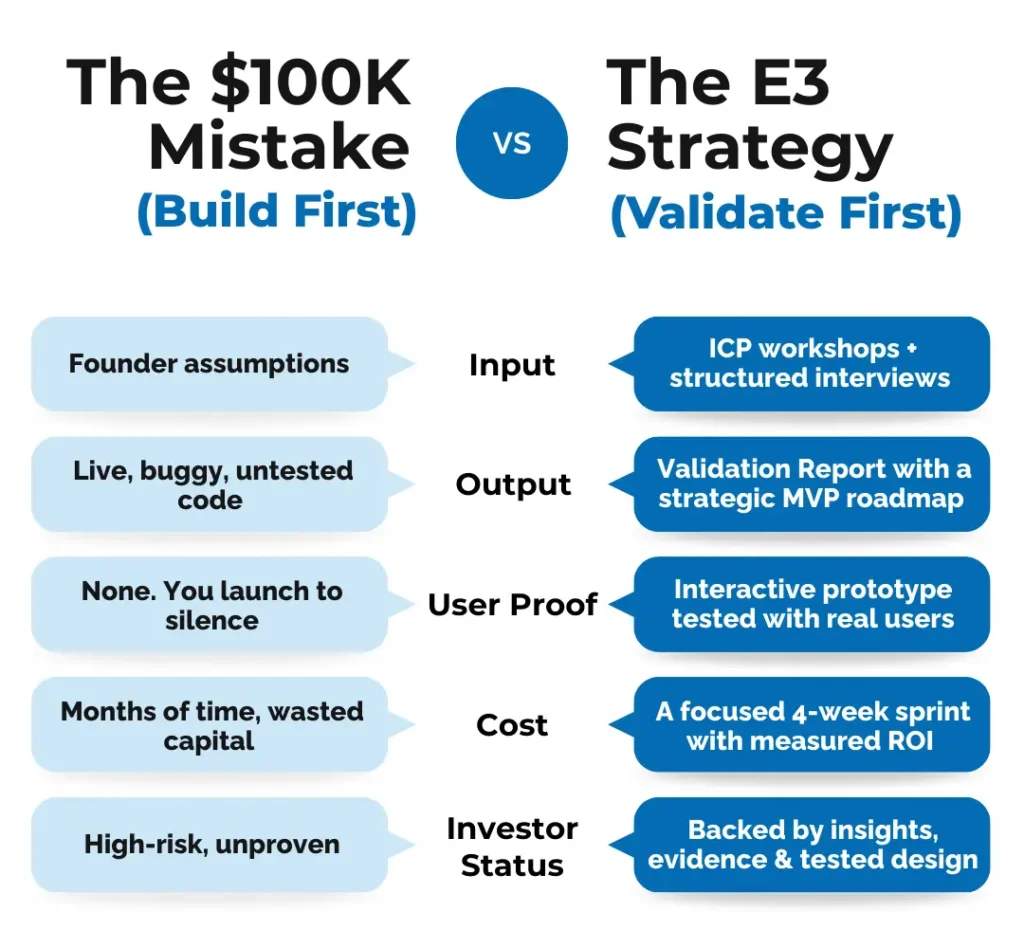
These five simple activities produce useful data that shows who you talked to, what they said, what the validated MVP should include, and how customers reacted to your message and prototype. That is the exact Validation brief you need to give developers or investors.
This is What a Clear Example of What Validation Looks Like:
“We interviewed 10 potential customers; 7 described the same urgent pain; our outreach test produced 18 sign-ups; our interactive prototype completed task success with 6 out of 8 users. Based on this, the MVP roadmap focuses on these three features.”
Next Steps
If you want help running these steps, we can lead the process and deliver a Validation Report and MVP roadmap in four weeks. If you want to do it yourself, follow the order above: interviews → competitor gap → outreach/test → prototype → pricing.
If you’d like us to run this validation for your idea, reach out and we’ll map a 4-week plan that fits your audience and budget.